Sauk County Dog Registration Information
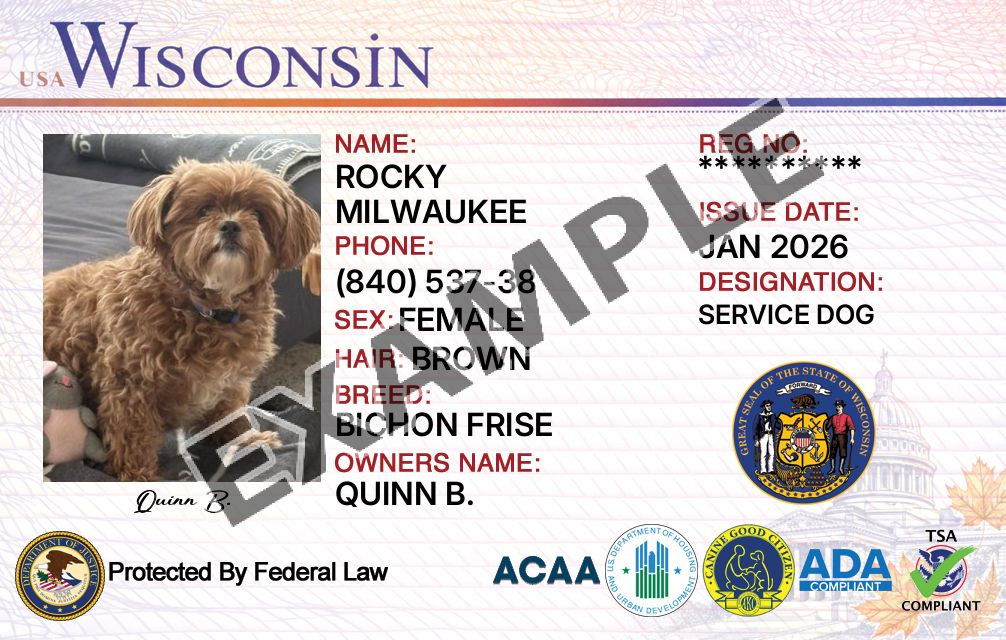
Service Dogs and Emotional Support Animals in Sauk, Wisconsin
If you’re searching “where do I register my dog in Sauk County, Wisconsin for my service dog or emotional support dog,” the key thing to know is that most residents are not registering a dog into a special service dog or emotional support dog “registry.” Instead, you typically complete a local dog license in Sauk County, Wisconsin through your city, village, or town (municipality)—most often via the Municipal Treasurer—and you provide the required documentation (commonly a current rabies vaccination certificate). Service dogs and emotional support animals (ESAs) may have different legal considerations, but those statuses generally do not replace local dog licensing requirements.
Where to Register or License Your Dog in Sauk County, Wisconsin
Use the offices below to get routed to the correct local licensing contact (your Municipal Treasurer) and to reach animal services support in Sauk County. Details shown are limited to information that could be verified from official or primary sources. If you live inside a specific city or village, your local clerk/treasurer may issue the license directly.
Sauk County Clerk (Dog Licensing Support / Municipal Treasurer Referral)
- Phone: (608) 355-3286
- Hours: 8:00 a.m. to 4:30 p.m. (weekday schedule listed)
Sauk County Humane Society Animal Shelter (Animal Services / Shelter Contact)
- Phone: (608) 356-2520
- Email: shelter@saukhumane.org
- Hours: Building/Animal Drop-off Hours: Daily 8:00 a.m. – 5:00 p.m.
Sauk County Dispatch (After-hours animal emergency / found animal contact)
- Phone: 608-355-4495
Overview of Dog Licensing in Sauk County, Wisconsin
What “registering your dog” usually means
In everyday terms, “registering a dog” in Sauk County usually means obtaining an annual dog license through your local municipality. Many Wisconsin communities require dogs to be licensed and to wear a tag. While the county provides guidance and coordination, the animal control dog license Sauk County, Wisconsin question often comes down to your specific city, village, or town procedures.
Municipality-based rules inside Sauk County
Sauk County includes multiple municipalities (cities, villages, and towns). Dog licensing procedures, office locations, and fee amounts can vary based on where you live. That’s why the county directs residents to their Municipal Treasurer first. If you’re not sure where to start, call the Sauk County Clerk’s Office and ask for the correct licensing contact for your exact address.
Common licensing expectations (what most residents encounter)
- Licenses are commonly issued annually and associated with your municipality (not a private company).
- A current rabies vaccination certificate is commonly required to obtain or renew a license.
- Some municipalities differentiate fees based on spay/neuter status.
- Your dog may be required to wear a tag as proof of licensing.
What You Need Before Registering a Dog
Documents and details to gather
Before you contact your Municipal Treasurer for a dog license in Sauk County, Wisconsin, it helps to have the typical items ready. Requirements can differ by municipality, so consider this a practical checklist rather than a guarantee.
- Rabies vaccination certificate (often required to issue a license)
- Owner identification (helpful for processing)
- Proof of address/residency in the municipality (especially if you recently moved)
- Spay/neuter documentation (if your municipality uses different fee tiers)
- Dog details such as age, breed/color, and name (common for license records)
- Payment method accepted by your municipality (some accept check, cash, or card; policies vary)
Do service dogs or ESAs need rabies vaccination proof?
In most local licensing systems, the license is tied to basic public health and identification standards (including rabies vaccination). Service dog status or ESA status does not typically eliminate standard animal health requirements. If you have questions about a specific exemption or reduced fee, ask your Municipal Treasurer directly.
Steps to Register or License a Dog in Sauk County, Wisconsin
Step 1: Identify your municipality (city, village, or town)
Because licensing is handled locally, first determine whether you live in a specific city/village (for example, if your mailing address is within a city) or in a town. If you’re unsure, your property tax bill, voter registration address, or municipal boundaries can help.
Step 2: Contact your Municipal Treasurer to obtain the license
The Municipal Treasurer typically provides the application process, fee amount, and accepted documentation. They can tell you whether licensing is available in person, by mail, or through a local form submission method. This is the core answer to where to register a dog in Sauk County, Wisconsin: the correct municipal office for your residence.
Step 3: If you don’t know the right Treasurer, call the Sauk County Clerk
Sauk County’s official dog licensing guidance indicates that if you are unsure who your Municipal Treasurer is, you can call the Sauk County Clerk’s Office to get the correct contact information.
Step 4: Submit required proof (often rabies certificate) and pay the fee
Municipalities commonly require proof of current rabies vaccination. You may also be asked for spay/neuter documentation if fee schedules differ. After submission and payment, you typically receive a license record and tag.
Step 5: Keep your license/tag information accessible
Keep a copy of your paperwork and confirm whether your dog must wear the tag at all times. Local ordinances and enforcement practices can vary across Sauk County municipalities.
Service Dog Laws in Sauk County, Wisconsin
No universal federal “service dog registration”
Service dogs are generally defined by their training to perform tasks for a person with a disability, not by being listed in a registry. There is not one universal federal government registry where you “register” a service dog for public access rights across the United States. In practice, your local dog license is handled through your municipality, while service dog status is tied to disability law and the dog’s training and function.
How service dog status interacts with local dog licensing
Even if your dog is a service dog, you typically still follow local dog licensing requirements (unless a specific local or state rule provides an exception). Your Municipal Treasurer is the right place to ask about any service-dog-specific fee handling, documentation preferences, or tag issuance in your municipality.
Practical tip for local records
When you request a license, you can ask your municipal office how they record service animals in their system (if they do at all). Some offices may only record standard licensing details (owner, address, rabies, spay/neuter), because licensing is not the same thing as a disability-status verification process.
Emotional Support Animal Rules in Sauk County, Wisconsin
No universal federal “ESA registration”
An emotional support animal (ESA) is generally associated with a person’s need for emotional support and is most commonly relevant in certain housing contexts. Like service dogs, there is not one universal federal government registry where you register an ESA for broad public access. If your question is specifically where do I register my dog in Sauk County, Wisconsin as an ESA, the local process you can reliably complete is still the municipal dog license for your residence, following the standard licensing requirements.
How ESA status interacts with dog licensing
ESA status typically does not change rabies vaccination requirements or local licensing expectations. If you’re dealing with a landlord or housing provider, their documentation process is separate from your municipal dog licensing process. Your municipal treasurer can advise on licensing steps; housing-related ESA questions are usually handled through housing policies and applicable disability accommodations.
Comparison: Dog License vs. Service Dog vs. Emotional Support Animal
| Category | Dog License (Local) | Service Dog | Emotional Support Animal (ESA) |
|---|---|---|---|
| What it is | A local license/tag issued by your city/village/town for dogs kept in that municipality. | A dog trained to do specific work or tasks for a person with a disability. | An animal that provides emotional support; commonly relevant to certain housing accommodations. |
| Who issues it | Your Municipal Treasurer (local government), based on Sauk County’s official guidance. | No single government office “issues” service dog status; it is based on training and legal definition. | No single government office “issues” ESA status; it is typically supported by appropriate documentation for accommodation contexts. |
| Is there one universal registry? | No; it’s local to your municipality. | No universal federal government registry. | No universal federal government registry. |
| Common documentation | Rabies vaccination certificate; owner/address details; sometimes spay/neuter documentation. | Training to perform tasks; practical demonstration/behavior is often what matters in real-world settings. | Documentation used for accommodations (commonly in housing-related contexts); not a substitute for rabies/licensing rules. |
| Does it replace local licensing? | Not applicable. | Usually no—service dog handlers typically still follow local dog licensing requirements (ask your municipality about any exceptions). | Usually no—ESA status generally does not remove the need for a local dog license. |
| Best Sauk County “where do I go?” starting point | Your Municipal Treasurer; if unsure who that is, call the Sauk County Clerk’s Office. | License locally like any dog; legal questions relate to disability law and training, not a registry. | License locally like any dog; ESA questions are typically separate from municipal licensing. |
Frequently Asked Questions
Where do I register my dog in Sauk County, Wisconsin?
Sauk County’s official guidance indicates that each municipality handles dog licensing individually. For most residents, “registering your dog” means contacting your Municipal Treasurer to obtain a license. If you do not know which Municipal Treasurer serves your address, call the Sauk County Clerk’s Office for help identifying the right local office.
Do I need a dog license if my dog is a service dog?
Many communities still require local licensing even if a dog is a service dog. Service dog status is about the dog’s training and disability-related tasks, while licensing is a local government process for identification and public health compliance (often including rabies vaccination proof). Confirm any municipality-specific handling with your Municipal Treasurer.
Do I need a dog license if my dog is an emotional support animal (ESA)?
Typically, yes—ESA status usually does not replace local licensing. ESA status is generally not a municipal licensing category; local dog licensing is still tied to where you live and the municipality’s requirements.
What if I live in a city or village inside Sauk County?
If you live within a city or village, your licensing process may be handled by that specific municipal office (often the clerk/treasurer). The county’s guidance still points you to the Municipal Treasurer as the starting point.
Is rabies vaccination proof required to license a dog?
Rabies vaccination proof is commonly required for dog licensing. Because rules can differ by municipality, confirm the exact documentation requirements with your Municipal Treasurer when you apply or renew.
Register A Dog In Other Wisconsin Counties
Select your county below to get started with your dog’s ID card. Requirements and license designs may vary by county, so choose your location to see the correct options and complete your pup’s registration.
- Adams County Dog Registration
- Ashland County Dog Registration
- Barron County Dog Registration
- Bayfield County Dog Registration
- Brown County Dog Registration
- Buffalo County Dog Registration
- Burnett County Dog Registration
- Calumet County Dog Registration
- Chippewa County Dog Registration
- Clark County Dog Registration
- Columbia County Dog Registration
- Crawford County Dog Registration
- Dane County Dog Registration
- Dodge County Dog Registration
- Door County Dog Registration
- Douglas County Dog Registration
- Dunn County Dog Registration
- Eau Claire County Dog Registration
- Florence County Dog Registration
- Fond du Lac County Dog Registration
- Forest County Dog Registration
- Grant County Dog Registration
- Green County Dog Registration
- Green Lake County Dog Registration
- Iowa County Dog Registration
- Iron County Dog Registration
- Jackson County Dog Registration
- Jefferson County Dog Registration
- Juneau County Dog Registration
- Kenosha County Dog Registration
- Kewaunee County Dog Registration
- La Crosse County Dog Registration
- Lafayette County Dog Registration
- Langlade County Dog Registration
- Lincoln County Dog Registration
- Manitowoc County Dog Registration
- Marathon County Dog Registration
- Marinette County Dog Registration
- Marquette County Dog Registration
- Menominee County Dog Registration
- Monroe County Dog Registration
- Oconto County Dog Registration
- Oneida County Dog Registration
- Outagamie County Dog Registration
- Ozaukee County Dog Registration
- Pepin County Dog Registration
- Pierce County Dog Registration
- Polk County Dog Registration
- Portage County Dog Registration
- Price County Dog Registration
- Racine County Dog Registration
- Richland County Dog Registration
- Rock County Dog Registration
- Rusk County Dog Registration
- Sawyer County Dog Registration
- Shawano County Dog Registration
- Sheboygan County Dog Registration
- St. Croix County Dog Registration
- Taylor County Dog Registration
- Trempealeau County Dog Registration
- Vernon County Dog Registration
- Vilas County Dog Registration
- Walworth County Dog Registration
- Washburn County Dog Registration
- Washington County Dog Registration
- Waukesha County Dog Registration
- Waupaca County Dog Registration
- Waushara County Dog Registration
- Winnebago County Dog Registration
- Wood County Dog Registration